Two Housing Stocks, One Town
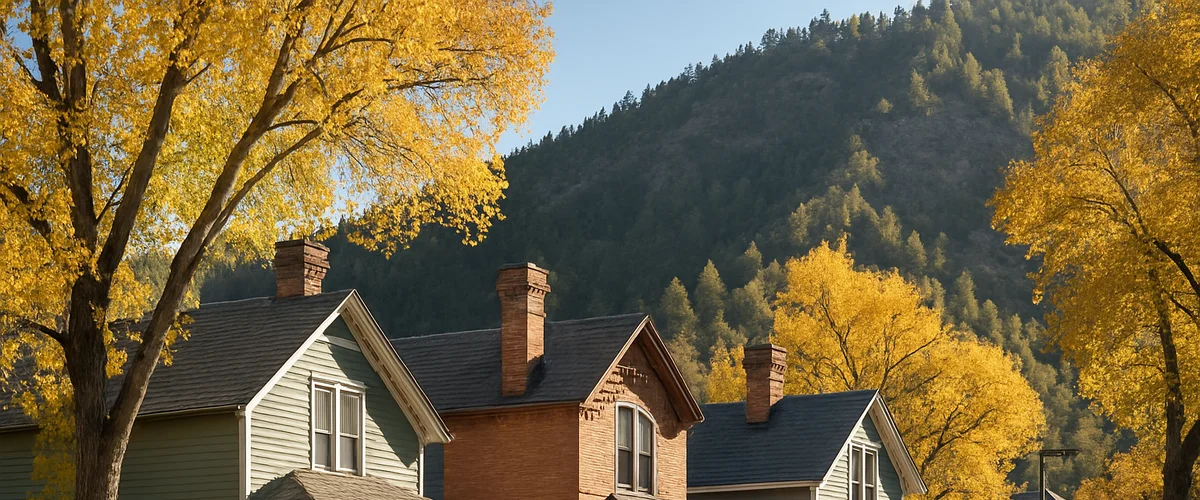
Durango is really two chimney markets sharing a zip code. Downtown and the north end of Main carry the 1880s-to-1920s stock the town is known for: brick, corbelled chimneys, clay tile liners where there is a liner at all, and crowns that have now taken well over a century of freeze-thaw at 6,500 feet. Then there is everything built up the hillsides since - timber-frame and stone with class-A insulated pipe, big fireplaces, and a fair number of houses occupied part of the year.
The failure modes are not the same. On the old brick the questions are crown cracking, mortar joints, and whether the tiles have shifted or spalled where an insert has been venting into them. On the newer builds there is no masonry to fail, but joints separate, storm collars perish, and the sheer height of some of these flues makes draft the recurring complaint rather than deterioration.
The Insert Problem in the Old Houses
This deserves calling out because it is specific to Durango's building stock and it turns up constantly. Somewhere between the 1970s and the 1990s a great many of the original fireplaces in this town had wood-burning inserts fitted into them. Some were properly lined up the chimney. A lot were not - the insert simply vents into the full-size masonry flue behind it.
An appliance sized for a six-inch liner exhausting into a flue several times that cross-section cools its gases far too fast. They condense on the way up and glaze the chimney, and the homeowner cannot square the state of the flue with how little they think they burn. If you have an insert in an original fireplace and nobody has ever pulled it forward, that is the single most useful thing we can look at for you.
Second Homes and Short-Term Rentals
Durango carries a lot of housing that is not lived in continuously, and intermittent heating is harder on a flue than steady heating. Every cold start condenses moisture in the chimney, and second stage creosote accumulates faster in a house used six weekends a year than in one heated straight through the winter. Nobody is on site to notice a cap that lifted in a spring wind, either.
If you manage a rental here, the useful discipline is a look before the season rather than a call after a guest complains about smoke in the living room.
Wildfire and Insurance, Specifically in La Plata County
Durango sits in the wildland-urban interface and the insurance market prices it that way. The county has adopted the state's 2025 Wildfire Resiliency Code, and since 1 July 2026 Colorado insurers using a wildfire risk model have to disclose your risk score annually and take account of mitigation you have completed. A compliant spark arrestor and a properly fitted cap are on the standard checklists. We fit them and we document them - see caps and spark arrestors for what that involves.
What we do in Durango
Most of our routes
Durango is where we are most days, so short-notice work is usually possible here when it is not elsewhere.
Get a Free Quote